

When are you remediating CVOCs? Use BOS 100. ZVI, if you must. But never use physical mixtures of activated carbon and ZVI— this is the worst choice you could make!
Zero-valent iron (ZVI), in one form or another, is likely the most used technology for remediating chlorinated solvent contamination (CVOCs) in soil and groundwater. It has been around since the early 1990s, and its first commercial use was in constructing permeable reactive barriers (PRBs). So-called “Iron Walls” were disclosed in US Patent 5,266,213 by Robert Gillham and the University of Waterloo in Canada.
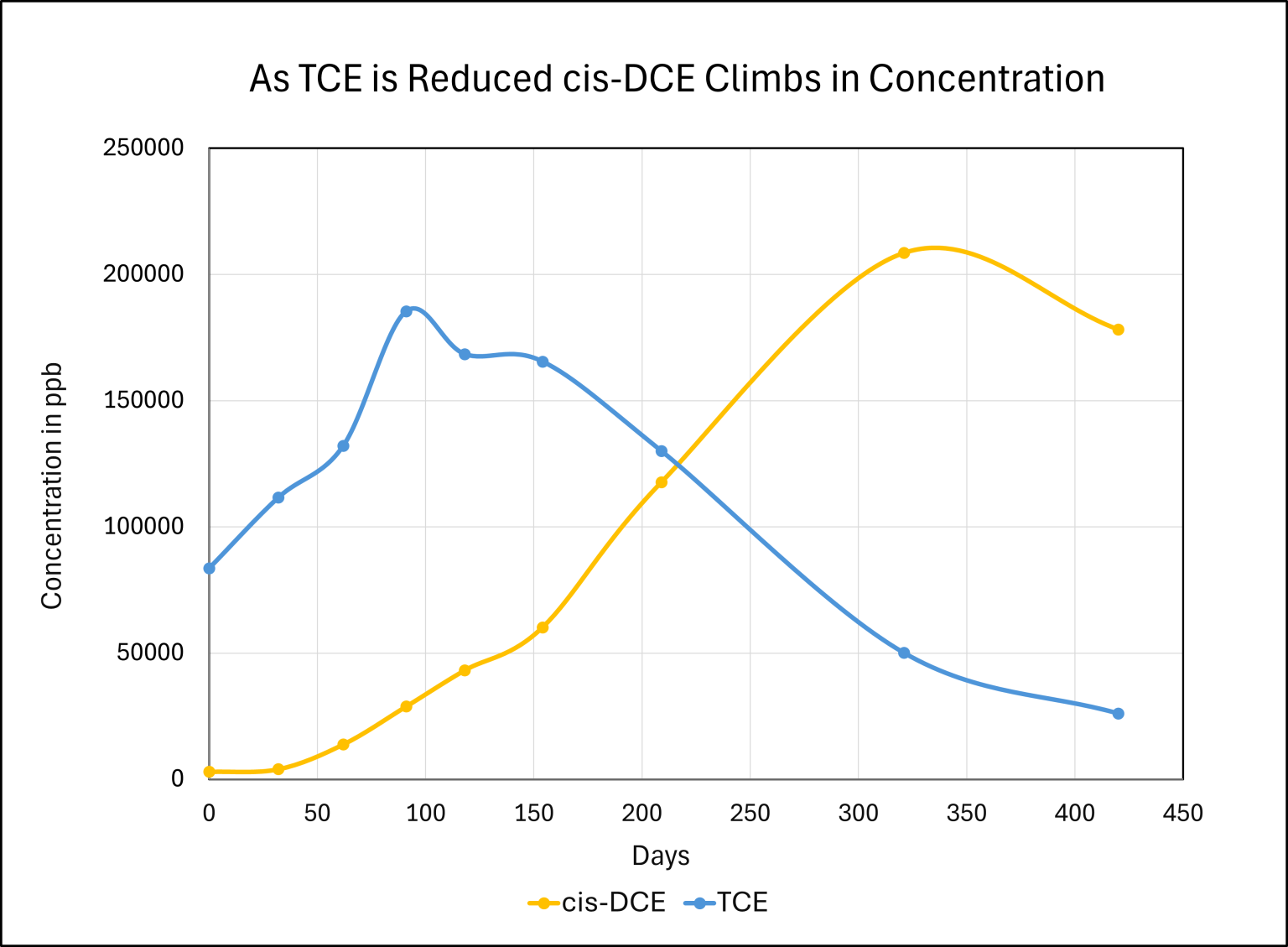
Figure 1 shows typical results for the in situ injection of ZVI powders. It is not uncommon for concentrations of parent compounds like trichloroethane (TCE) to increase due to the mobilization of CVOCs from saturated soil by the in situ effort. Over time, the parent compounds trend down primarily due to degradation by the iron.
Graph 1. Rising Daughters: This graph shows groundwater CVOC concentrations post-ZVI in situ injection. While the TCE concentrations drop significantly, the daughter product cis-DCE climbs. While not shown in this graph, vinyl chloride will also climb as cis-DCE decreases.
Over time, some limitations of ZVI Powders became clear:
Over the years, many improvements to ZVI were introduced to address the above limitations. Micro and nanoscale iron powders were developed because the reaction rate is tied to the metallic surface area; as the particle size is reduced, the available surface area increases, and the reaction rate increases. ZVI emulsified with vegetable oil was introduced by NASA to target heavily impacted (DNAPL) sites. These products performed considerably better than previous coarse powders; however, they didn’t surmount being short-lived in the subsurface, having a life expectancy measured in months rather than years.
Robert Gillham at Waterloo explored another pathway: a mixture of ZVI with absorbents described in US Patent 5,534,154 filed in July of 1996. Contact time was the most significant limitation of the prior “Iron Wall” PRB. Contaminants like cis-DCE react slowly with ZVI, so residence time is a critical parameter. The idea behind this patent is that by using a mixture of adsorbent (like activated carbon) and ZVI, the adsorbent will retard the movement of the contaminant, keeping the contaminant close to the ZVI. Quoting from the patent, “it may be regarded that the adsorptive material acts as a retarder, to retard the passage of the contaminant and to keep the contaminant in close proximity to the metal for a very long period.”
A few years later, one of Dr. Gillham’s graduate student (Aiping Huo) conducted research in fulfillment of a Master of Science degree directed at mixtures of sorbents and ZVI (Huo, 2001). After evaluating several absorbents, Huo concluded that a “sorptive material with reversible and fast adsorption and desorption rates is a preferred material…” for the application.
Activated carbon is very effective at adsorbing organic compounds due to its extensive inner pore structure and total surface area. The surface area is on the order of 900 to 1200 m2 per gram of activated carbon. However, almost all the adsorption is confined to the micropore structure within the grains. When contaminants, such as CVOCs, are bound inside the activated carbon, those CVOC molecules are unavailable for interaction with ZVI.
Contaminants absorbed within GAC are prevented from contacting ZVI, no matter how homogeneous the mixture is, because the ZVI is outside and physically separated from the GAC. The GAC effectively isolates the contaminant, preventing its physical interaction with ZVI. This is why the patent for mixing ZVI and AC was never commercialized.

Illustration 1. While whimsical, it is clear no matter how vicious the piranhas (ZVI) are, the criminal (TCE) is safe if the piranhas can’t get to him. CVOCs bound inside activated carbon are not available for interaction with ZVI.
RPI introduced its BOS 100® product in November of 2004. In the production of BOS 100, activated carbon is impregnated with a solution of iron salt in a rotary furnace at 850 degrees centigrade under a reducing atmosphere. The iron salt decomposes at this temperature, liberating metallic iron that partially dissolves into the activated carbon, forming iron carbide and cast-iron nanoscale deposits within the structure of the activated carbon. The partially dissolved iron forms a chemical bond with the activated carbon. By this process, BOS 100® is not activated carbon and ZVI. It is a unique material with abilities that exceed those of ZVI and absorbents. Thermal melding led to integration, resulting in synergy between ZVI and activated carbon.
Let me explain. Degradation reactions are often modeled using first-order kinetics. In first-order kinetics, the rate of response is a function of concentration. Think about an adsorbent. It rapidly strips the contaminant from groundwater. Most of the contaminant will then reside in the microporous structure of the activated carbon. The concentration inside the carbon is easily two orders of magnitude higher than what originally existed in the groundwater. In BOS 100®, the metallic iron also resides within the microporous structure of the carbon. So when the CVOCs are adsorbed into the activated carbon, they are colocated with the elemental iron. Now, we have the metallic iron exactly where we want it – in direct contact with the contaminant. Not only is there contact, but the concentration of CVOCs within the carbon is 100 times higher than what was initially present in groundwater; thus, the degradation rate is 100 times faster. This effect is further enhanced because the metallic iron is dispersed as deposits across the graphite plates within the activated carbon. The result is that the metallic surface area within BOS 100® is more extensive than any commercial, nanoscale ZVI product. BOS 100® is the perfect marriage between activated carbon and metallic iron. It differs entirely from the physical mixtures of AC and ZVI described in the Waterloo 154 patent.

Illustration 2.BOS 100® is not a physical mixture of activated carbon and ZVI. It is metallic iron partially dissolved into the activated carbon, forming iron carbide and cast-iron deposits on the graphite plates of the activated carbon. Thus, BOS 100 is a unique material with abilities that exceed those of ZVI and activated carbon.
Three test vials were set up to evaluate the performance of sulfided microscale ZVI, BOS 100, and a mixture of sulfided ZVI and activated carbon. 3.25 g of a brand-name sulfided microscale ZVI, 3.25 g of the same ZVI mixed with 325 mg of AC, or 5 g of BOS 100, which has 325 mg of iron integrated into its AC structure, were dosed with 500 ppm of TCE in tests that were otherwise identical. The ZVI has 10x more iron by dose than the BOS 100.
In Graph 2, TCE concentration versus time for the ZVI-only test shows that the TCE concentration minimally decreases (blue line). The ZVI and AC combination fares better (green line). The BOS 100 performs the best (orange line). Most vendor presentations stop at this graph, the results of which are absorption-driven. But degradation is quintessential to environmental restoration. Sold proof of TCE degradation is chloride generation.

In Graph 3, the chloride generation over time does not mirror the TCE decrease observed in the first graph. BOS 100 leads the pack in chloride generation. In contrast, ZVI generates 8.5x less chloride than BOS 100 but still outperforms the ZVI and AC mixture, which is the least effective of the three.

Graph 3. BOS 100 generates the most chloride. BOS 100 achieved over 50% TCE mass destruction within 12 days.
The contrast between the ZVI and the ZVI and AC mixture is telling. In the first graph, the ZVI and AC mixture absorbs the TCE, lowering its concentration in the solution. This same absorption protects the TCE from the ZVI, so less chloride is produced than by ZVI alone. The BOS 100 is different. When TCE is absorbed, it collocates with the iron. Therefore, BOS 100 generates 16x more chloride than the ZVI and AC mixture.
Longevity refers to the duration over which a product continues to support or perform its intended reactions. It is the core measure of a product’s quality. Poor quality, that is, short longevity, results in the need for multiple reinstallations of a product. While it is possible to install a product multiple times, installation costs are primarily driven by mobilization and time spent in the field rather than the cost of the product itself. Therefore, remedies that lack longevity may initially be lower in price, but in the long run, as mobilizations, reinstallations, and maintenance accumulate, they ultimately become high-cost.
BOS 100® persists in degrading halogenated compounds long after vegetable oils, ZVI (sulfonated and otherwise), and various other products have been consumed, passivated, or in some manner rendered ineffective. BOS 100® attains its quality through time in the furnace. ZVI is not mixed or soaked into the activated carbon. Metallic iron is co-fired at 850°C with activated carbon under a reducing atmosphere. In this process, the elemental iron and activated carbon become an inseparable molecular structure with characteristics that surpass those of either activated carbon, zero-valent iron (ZVI), or a mixture of both. One of these characteristics is longevity.
Graph 4 presents the data from a BOS 100 in a PRB application (Blue line). The hashed vertical line indicates the installation of the PRB. against an untreated, upgradient area (Orange line). Total CVOCs immediately dropped, and this trend persisted over the next nine years. Approximately six years after the PRB installation, the area around the untreated control (Orange line) was treated with an in situ injection, as indicated by the vertical black line. Total CVOCs have been restrained for about 3 years. The regulatory authority has placed the site in managed closure.

Graph 4. Total CVOCs (Ethenes only) Versus Time. After BOS 100 installation, CVOC concentrations remained low for 9 years. When the upgradient control area was treated, concentrations of CVOCs fell and remained low.

Picture 1. The apartment building above was built after BOS 100 treatment brought about site closure.
The extensive apartment complex pictured above was not there long ago. Instead, there was an open field with soil and groundwater heavily impacted by TCE. DNAPL existed at multiple locations with TCE at 25,000 to 54,000 ppm in soil. Groundwater TCE was in the hundreds of ppm. Site remediation could have been considered technically impractical. RPI’s BOS 100® was used at the site, and years later, the complex above was built on DNAPL ground zero!
Figure 1. illustrates the stratigraphy of the site, which consists of river deposits and sedimentary bedrock. The impacted alluvium includes approximately 5 meters (m) of interbedded granular and fine-grained deposits. Beneath the source area were approximately 15 meters of well-graded sands and gravels underlain by an aquitard of silt and silty clay, where DNAPL pooled at the interface. The impacts terminated in claystone.

Figure 1. illustrates the stratigraphy of the site, which consists of river deposits and sedimentary bedrock. The impacted alluvium includes approximately 5 meters (m) of interbedded granular and fine-grained deposits. Beneath the source area were approximately 15 meters of well-graded sands and gravels underlain by an aquitard of silt and silty clay, where DNAPL pooled at the interface. The impacts terminated in claystone.
Before in situ injection, quantitative, high-resolution characterization was performed to support the design, field implementation, and performance monitoring. This characterization revealed the site’s inherent complexity. Table 1. shows how subtle facies changes correspond to soil contaminant concentrations that varied by orders of magnitude across only centimeters (cm) of ditance.

Table 1. Field PID readings and associated TCE laboratory results for soil samples demonstrated TCE concentrations varied significantly across narrow intervals. For example, a change of 3 orders of magnitude was noted over less than 0.1 meters of depth as TCE increased from roughly 54 ppm to over 25,000 ppm (marked in yellow).
After BOS 100 in situ injection, DNAPL portions of the plume were reduced from percent-level concentration to closure levels. The dissolved phase plume was also mitigated, and site-closure monitoring began in 2011. A Request for No Action Determination was submitted, and site closure was granted.

Picture 2. The apartment buildings on the right and the grocery store on the left side of the picture were part of the development that included the apartment building in Picture 1. – a development made possible by BOS 100.
Gillham, U.S. Patent 5,266,213, Nov 30, 1993.
Gillham, R.W. and O’Hannesin, S.F., 1994. Enhanced degradation of halogenated aliphatics by zero-valent iron. Ground Water, Vol.32, No.6, pp. 958-967.
Gillham, U.S. Patent 5534154, Nov 30, 1996.
Huo A, University of Waterloo. Department of Earth Sciences. Addition of Sorbent to Iron for Treating Contaminant Stream with Variable Loading. University of Waterloo; 2001.
Noland, U.S. Patent 8,097,559 B2, Aug 11 2004.
Reinhart et al., U.S. Patent 6,664,298 B2, Oct 2001.
Reinhart er al., U.S. Patent 7,037,946 B1. May 2, 2006.