

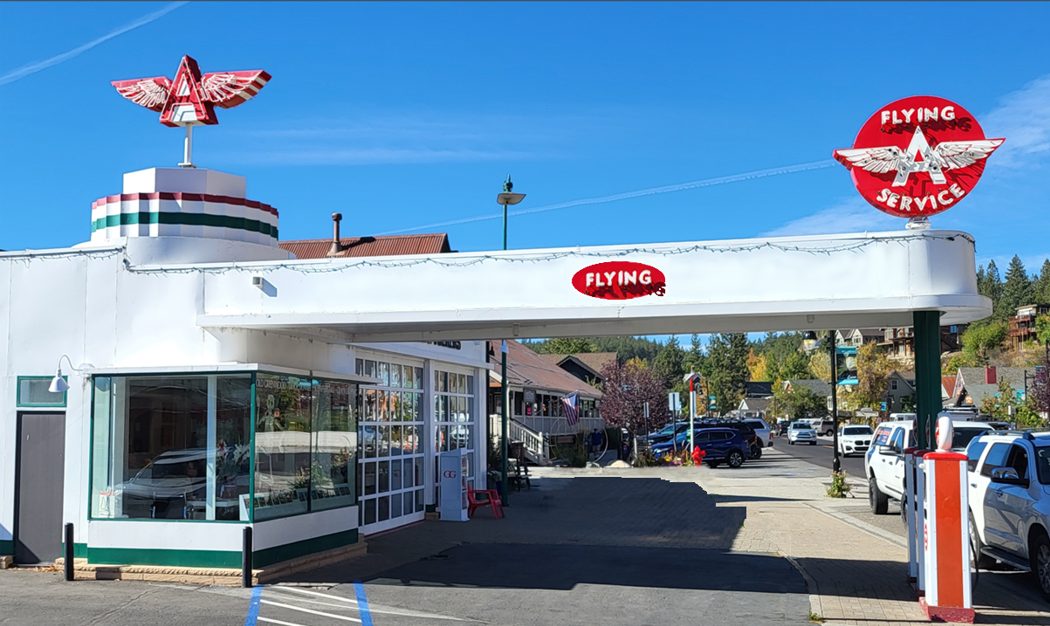
Flying A Service was emblematic of the airplane-inspired, streamlined style of the 1930’s.
The power of events to capture our imagination is surprising. Charles Lindbergh’s historic flight from New York to Paris in 1927, followed by Amelia Earhart’s groundbreaking transatlantic journey in 1932, captured the nation’s imagination. These pioneering feats sparked an obsession with flight. The rounded, streamlined form permeated products from clothing and trains to cars and buildings. The influence of aviation was transformative; even gas station designs were shaped by airplanes.
The Flying A station evokes the spirit of aviation. The canopy is rounded, the globes on the pumps are rounded, a control tower-like cylinder is on the roof, and the “A” is festooned with wings. Once you notice the theme, it’s impossible not to see it.
We may think this “capturing of the mind” was a quaint, naive character of that time, but we’re not so different. Ideas are like style – everyone knows style, but few can explain it, and most just follow it.
Not long ago, many in petroleum remediation thought activated carbon (AC) locked up contamination. No destruction, just immobilization. Oxidants dominate petroleum remediation even though a simple calculation shows that you must apply oxidants many times to achieve remediation on all but the most trivially contaminated sites. Multiple U.S. oil companies were giving sulfate injections the hard sell and not without reason. Some companies would not execute a state directive unless it was for more sulfate. I’m sure a site or two must have been closed, but I can’t recall one.
Regardless, RPI’s imagination and research lead us in a transformative direction. The BOS 200® line of products includes sulfate and nitrate as well as multiple microbes to support biodegradation, and its performance is beyond that of adsorption. But at the time, the idea of AC as a sponge had “captured the mind.” I guess we were out of style! The style has changed, and multiple companies are selling activated carbon-based products. We’re flattered.
But while they are busy catching up, we’ve been moving on. RPI has incorporated lessons from our 22 years of experience, added nutrients to the electron acceptors, and expanded out microbial consortia to create BOS 200+, a proven, transformative technology that readily tackles LNAPL.
A link to a case study demonstrating the capability of BOS 200+ to achieve project objectives rapidly is at the bottom of the Newsletter.