Cost-Effective Remediation Strategy: 5-Step Framework

Blog

4 MIN READ

Selecting remediation technologies involves a recurring dilemma between controlling up-front costs and ensuring long-term effectiveness. Available budget must be balanced against desired outcomes and timeframes. 

A defensible business case for cost-effective remediation requires a structured approach that weighs total costs, long-term liability reduction, and progress toward site closure against initial bid prices. This framework provides the strategic tools needed to evaluate technologies based on value rather than price alone.

Step 1: Define Your Financial Baseline with High-Resolution Data

Accurate budget planning depends on understanding the full extent of the problem through comprehensive site characterization. High-resolution data from a process like Remedial Design Characterization provides the foundation for defensible cost forecasting.

Remedial Design Characterization delivers two critical benefits:

  1. Prevent costly surprises: A detailed conceptual site model built on robust data prevents scope creep and unexpected costs that derail projects. Understanding contaminant distribution, migration pathways, and subsurface conditions eliminates the guesswork that leads to budget overruns. Proper characterization also allows you to accurately quantify environmental liability for financial planning and stakeholder communication.
  2. Enable surgical precision: An accurate budget depends on knowing exactly how much product to apply and where. Quantifiable high-resolution data provides a subsurface map that allows for surgical application, eliminating wasteful application practices. This precision directly translates to cost savings through optimized material usage and reduced application time.

Step 2: Model Life-Cycle Costs to Prove Long-Term ROI

cost-benefit analysis for a remediation project must look beyond the initial price and project costs over the entire project life cycle. True return on remediation investment is measured through multiple key performance indicators that capture both direct costs and risk reduction value.

Essential metrics for evaluating long-term value include:

  • Total cost of ownership (TCO): Calculate the sum of up-front technology costs, installation expenses, ongoing monitoring, maintenance requirements, and long-term operation costs. Technologies with higher initial costs may deliver lower TCO through reduced monitoring frequency and faster site closure.
  • Projected time to site closure: Every additional year of monitoring and regulatory oversight adds costs. Accelerated site closure reduces cumulative expenses and frees properties for redevelopment sooner.
  • Year-over-year reduction in operations and maintenance costs: Reduced intensity and frequency of long-term monitoring activities yield measurable savings. Model these savings across the expected project duration to demonstrate value accumulation over time.
  • Cost of risk: Failed remedies require retreatment or a new effort and can double or triple project costs. Quantify the financial impact of application failure by modeling the cost of starting over, including lost time, additional sampling, and stakeholder confidence erosion.

Step 3: Apply Value Engineering to Your Technology Selection

Value engineering (VE) is an organized method for maximizing success while minimizing life cycle cost. It is a critical practice for reducing nonessential costs and improving productivity on major projects. When applied to remediation strategy development, VE becomes a powerful framework for systematic technology selection.

The function of a remediation technology extends beyond the product. It includes the entire support system needed for successful implementation, such as the design methodology, the quality of laboratory support, and the expertise of the installation teams. From a VE perspective, any technology feature that reduces project risk dramatically increases its value score by directly protecting the project’s budget and timeline.

A core VE tenet is choosing the option with the lowest total life-cycle cost. This principle supports investment in more durable and effective technology as the superior decision. Remediation cost optimization occurs when initial spending eliminates the need for costly interventions, retreatment, or extended monitoring periods. The low bid rarely reflects true project value.
Step 4: Select a Technology Partner to Guarantee Success

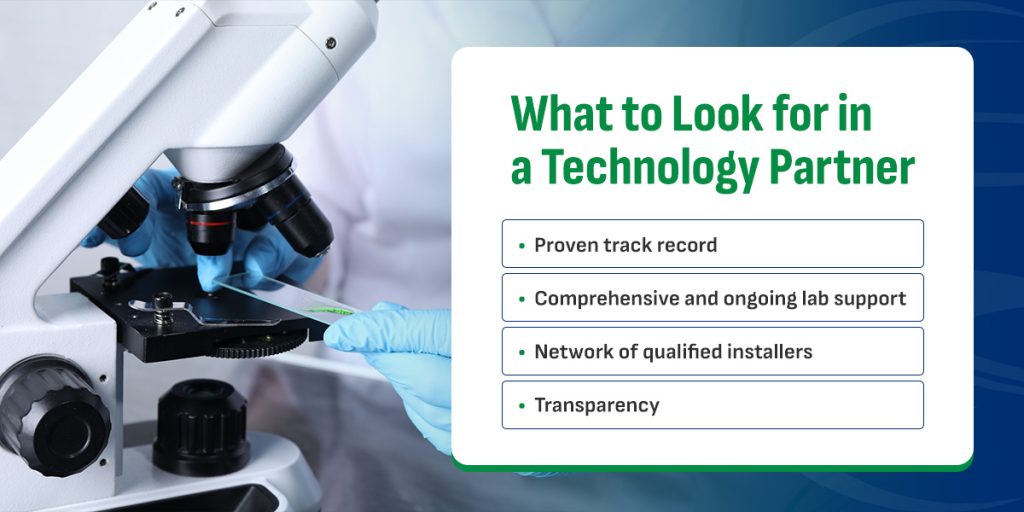
gloved hands putting a sample under a microscope with text explaining what to look for in a technology partner

A strategy is only as good as its execution. Choosing the right technology partner is a critical step in environmental remediation strategy development. A true technology partner is invested in the remediation firm’s success, with a business model based on empowering firms with better tools and data rather than replacing them.

Essential qualities to look for in a technology partner include:

  • Proven track record: Evaluate case studies and project histories that demonstrate successful applications across multiple site types and contamination scenarios. Technologies with documented performance reduce the risk profile of your project.
  • Comprehensive and ongoing lab support: A key differentiator is a provider who delivers robust analytical support throughout the project life cycle, not just at the beginning. Thousands of samples analyzed annually at no charge to partners is a significant value proposition that removes traditional financial barriers to gathering the data needed for accurate decision-making.
  • Network of qualified installers: Proper execution is just as important as proper design. Using specialized installation teams ensures the technology is applied correctly, preventing application errors that lead to performance failures and costly remediation.
  • Transparency: Partners who provide clear documentation, open communications, and honest guidance about site suitability build the trust necessary for long-term collaboration.

Step 5: Secure Project Funding and Financing

Once a solid business case is established through the first four steps, multiple pathways become available for funding large-scale projects. Understanding different financing mechanisms allows you to select the option best suited to your project scale and timeline.

Common funding pathways include:

  • Governmental bonds: Municipal or state bonds can finance public sector remediation projects with favorable interest rates and extended repayment terms.
  • Private activity bonds: These instruments allow private entities to access tax-exempt financing for qualified environmental remediation projects.
  • Revolving loan funds: State and federal programs offer low-interest loans for environmental cleanup, with repayment terms tied to project completion and property redevelopment.
  • Tax incentives: Brownfield tax credits and other incentive programs reduce the net cost of remediation by providing credits against future tax liability.

Public sector projects typically pursue governmental bonds or revolving loan funds, while private remediation efforts more commonly leverage tax incentives or private activity bonds structured around property redevelopment timelines. The strength of your business case directly influences financing accessibility. Projects supported by high-resolution data, comprehensive cost modeling, and proven technology partnerships present lower risk profiles to funding agencies and attract more favorable financing terms.

Develop Your Cost-Effective Remediation Strategy with RPI®

A truly cost-effective remediation strategy prioritizes data-driven decision-making and long-term value over initial price points. Remediation Products Inc. (RPI®) provides the comprehensive support remediation firms need to build defensible strategies from site assessment through closure. 

Our Remedial Design Characterization framework delivers high-resolution data at no additional cost, while our advanced product portfolio and network of approved installers ensure proper application and project success. 

Partner with a technology manufacturer committed to empowering your firm with superior tools and ongoing analytical support. Contact us today online or call us at 303-385-0386 to develop your next cost-effective remediation strategy.
female field worker with a call-to-action to develop your cost-effective remediation strategy with Remediation Products, Inc.
Previous ArticleRemedial Design Characterization: Data That Drives Results Next ArticleThe Strengths of RPI Group Companies: Considerations for Choosing a Remediation Partner