Making Amends: The Human Side of Remediation

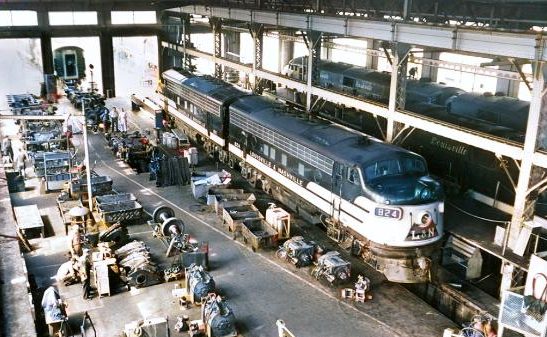
The picture is from inside the L&N maintenance barn on June 29th, 1951. Catwalks supported cleaning the sides and tops of the locomotives, while pits allowed access to degrease the undercarriages. The L&N maintenance facility was demolished to make way for the University of Louisville Cardinal Stadium, which is now called the L&N Federal Credit Union Stadium. 

It is easy to get immersed in a project and the associated logistics, characterization, remedy selection, and monitoring, but every so often, we need to pause and remind ourselves why we do this work in the first place.

The University of Louisville Cardinal Stadium, a couple of miles from my home, regularly reminds me of how pervasive the use of chlorinated solvents has been and why we do our work. Where the stadium sits today was once a locomotive repair and cleaning facility. Workers using pressure washers blasted grim from locomotives with solvents such as TCE inside a semi-enclosed “barn”.

As a student, I used to park my car near the cleaning barn. The air had a slight fruity smell, but I thought nothing of it.

We now know that more than 600 U.S. railroad workers cleaned locomotives from the 1950s through the early 1990s, with little to no protection, using solvents like 1,1,1-trichloroethane, trichloroethylene, and perchloroethylene. The way the solvents were utilized resulted in significant exposure to the workers. Exposures now linked to brain damage.

The condition that arises is known as toxic encephalopathy, and it presents as chronic depression, memory loss, and unpredictable mood changes. The connection was first brought to light in a 2006 study published in the Journal of Occupational and Environmental Medicine (Haut, 2006) and has since been confirmed by numerous other researchers.

In the field of remediation, we are the hands of industry striving to make amends for past mistakes. It’s not just about hitting regulatory endpoints. It’s restoring trust, protecting future generations, and honoring those who unknowingly bore the burden of exposure.

*A one minute case study demonstrating the capability of CAT 100 to encourage and sustain a dechlorinating population is in this newsletter.

                                Edward Winner

                                Vice President, RPI

Dehalococcoides from EM image colorized.

Webinar

Enhancing Dehalococcoides Populations Without Augmentation: Insights from Chlorinated Solvent-Contaminated Sites Treated with CAT 100

Background/Objectives

Dehalococcoides (Dhc) are among the most well-known bacteria in bioremediation and are often introduced to sites via augmentation cultures. We will examine multiple chlorinated solvent-contaminated sites treated with CAT 100 without Dhc augmentation and demonstrate the emergence or increase in abundance of Dhc population.

Approach/Activities

The investigation focuses on chlorinated contamination sites that have been treated with CAT 100. The microbial populations were analyzed using Next-Generation Sequencing (NGS), complemented by soil and groundwater data.

Results/Lessons Learned

Results demonstrate that Dhc populations can increase from levels below NGS detection limits to comprising over 90% of the microbial community. The pattern is consistent across multiple sites. These findings underscore the potential to enhance Dhc abundance without external augmentation using CAT 100.

Thursday April 24th 12:00 EST

One Minute Case Study

We’ve noticed that dechlorinating bacteria rapidly appear and multiply in the groundwater of sites treated with CAT 100. We do not bioaugment with Dehalococcoides, but they are present post-treatment! In the table above, dehalogenating bacteria are not present in the control sample. They are present one year post–CAT 100 in situ injection and remain present in the second-year sample. This is not the only site for which we’ve seen this pattern; we’ve encountered it repeatedly and consistently on the sites we’ve tested. I will be presenting this and similar data in a webinar on April 24th at 12:00 EST. See above