
Contaminated site remediation often fails when initial characterization is insufficient. Remedial Design Characterization (RDC) provides quantitative subsurface data needed to design and implement an effective in situ remedy. In this guide, you will discover what RDC is, how it is applied, and why it is essential for solving complex contamination challenges.
RDC is the process of collecting high-resolution soil and groundwater data to support in-situ remediation design and implementation. Unlike general site characterization strategies, which determine whether contamination is present, RDC gathers detailed subsurface data with the resolution needed to design a remedy. RDC answers critical questions such as:
The result is a quantitative, high-resolution dataset that directly supports the efficient and effective implementation of remedies.
Understanding how RDC is applied in practice requires understanding how RPI® Group works. Environmental consulting firms manage contaminated sites for property owners, evaluating site conditions and coordinating remediation efforts. The RPI Group of companies collaborates with consultants to conduct RDC by collecting supplemental samples and analyzing data in support of remediation design. This includes collecting dense, vertically and laterally distributed samples and integrating them with historical site data.
RPI Group companies incorporate the robust RDC dataset into a Quantitative High-Resolution Conceptual Site Model. The CSM is then used to develop a precise remediation plan for deploying RPI products.
One of the most common mistakes that leads to an unsuccessful remediation program is reliance on low-resolution or generalized CSMs. Such CSMs often rely on composite groundwater samples from the entire saturated water column, sparse soil analytical data and historical datasets lacking spatial resolution. The presumptions arising from these CSMs lead to incomplete contaminant delineation, inefficient product deployment, extended project timelines, and increased costs.
RPI Group’s approach to successful remediation begins with conducting an RDC to obtain densely distributed soil and groundwater samples. These samples are analyzed in a fixed-base laboratory to ensure high-quality, defensible data. The resulting dataset is then used to identify contaminant locations and concentration variability, enabling the development of a high-resolution understanding of contamination within its geological context, including key media and aquifer properties. This process produces a geologically informed, high-resolution understanding of contaminant distribution that directly guides remediation strategy.
RDC is equally critical in fractured bedrock and consolidated formations, where contaminant transport is controlled by discrete transmissive features rather than bulk porosity. Accurate assessment of the formation and discrete interrogation of transmissive features is critical to precise amendment placement so that amendment contacts transport and storage zones. RPI Group personnel employ well-established geophysical tools and techniques, along with proprietary methods, to gain greater insights into the fate and transport of contaminants in complex geologic settings.
The remediation-focused RDC is foundational to closing sites using in-situ remediation technologies.
RDC is an up-front investment that reduces uncertainty and improves remediation outcomes, often lowering total life cycle costs. Proceeding with inadequate data typically leads to remedy adjustments, extended monitoring, and in worst cases, complete redesign — far more expensive than proactive characterization.
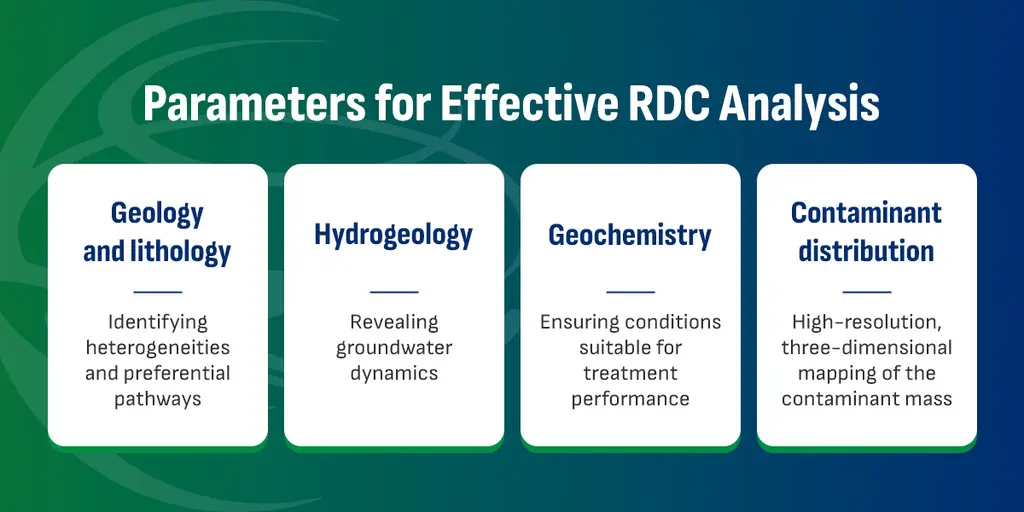
RDC addresses four critical parameters:
RDC employs high-resolution site characterization techniques that collect data at scales matched to subsurface variability. Where conventional approaches space borings 50 to 100 feet apart, RDC uses horizontal intervals in tens of feet and vertical intervals of less than 1 foot, capturing heterogeneities that conventional spacing would miss.
Unlike investigations that rely on groundwater monitoring, RDC collects detailed soil and aquifer samples to identify where the contaminant mass is located. This data enables three-dimensional models that guide precise amendment deployment.
Field quality control during implementation, including injection pressure readings and real-time soil testing, is used to confirm product placement in accordance with the design. This approach allows mid-project adjustments to optimize outcomes.
As needed to support field efforts, the RPI lab completes sample analysis and provides results on the same day or overnight. In this way, the data can be used to direct product placement in the field.
Note that for samples collected outside the field implementation of the remedy, the RPI® Project Support Laboratory analyzes thousands of samples annually, with typical turnaround times of 30 days. Testing continues throughout the project lifecycle at no additional cost, regardless of project duration.
RDC proves especially valuable for NAPL-impacted sites, including both Dense Non-Aqueous Phase Liquid (DNAPL) and Light Non-Aqueous Phase Liquid (LNAPL) conditions.
DNAPL compounds — chlorinated solvents like perchloroethylene “perc” (PCE) and trichloroethylene (TCE) — sink below the water table and migrate along pathways controlled by subtle geologic variations. Without high-resolution characterization, DNAPL source zones remain undetected, continuously feeding dissolved plumes.
LNAPL contamination from petroleum hydrocarbons (gasoline, diesel, fuel oil) creates smear zones as water table levels fluctuate. RDC quantifies mass distribution, enabling strategies addressing both free-phase product and residual saturation.
RDC methodology has delivered results across challenging contamination scenarios. Here are just three striking examples:
Fractured Bedrock Truck Stop: High-resolution characterization using 2D electrical resistivity imaging, borehole logging, and discrete groundwater sampling at 18-inch intervals identified fracture connectivity. Targeted BOS 200® injections resulted in a No Further Action letter being issued, confirming success.
Retail Dry Cleaner in Karst: High-resolution RDC using custom equipment in challenging karst conditions revealed contaminant distribution patterns that conventional characterization missed, enabling targeted BOS 100® injections. All monitoring wells dropped below 0.5 ppm PCE, with key wells below MCLs.
Active European Gas Station: RDC was performed at a gas station with NAPL impacts, including MIP surveys and 180 soil samples. The resulting 3D model directed surgical BOS 200® injection design across 267 locations. Benzene reductions of 92.4-99.9% were achieved within 4.5 years, with soil validation confirming total mass reduction.
RPI Group’s RDC methodology delivers the high-resolution data environmental consultants need for successful remediation strategies. Our approach combines:
Contact us to discuss how RDC can optimize your remediation design.